The latest data from ComReg shows that fibre is now firmly established as Ireland’s leading broadband technology, with Fibre-to-the-Premises (FTTP) subscriptions surpassing one million for the first time.
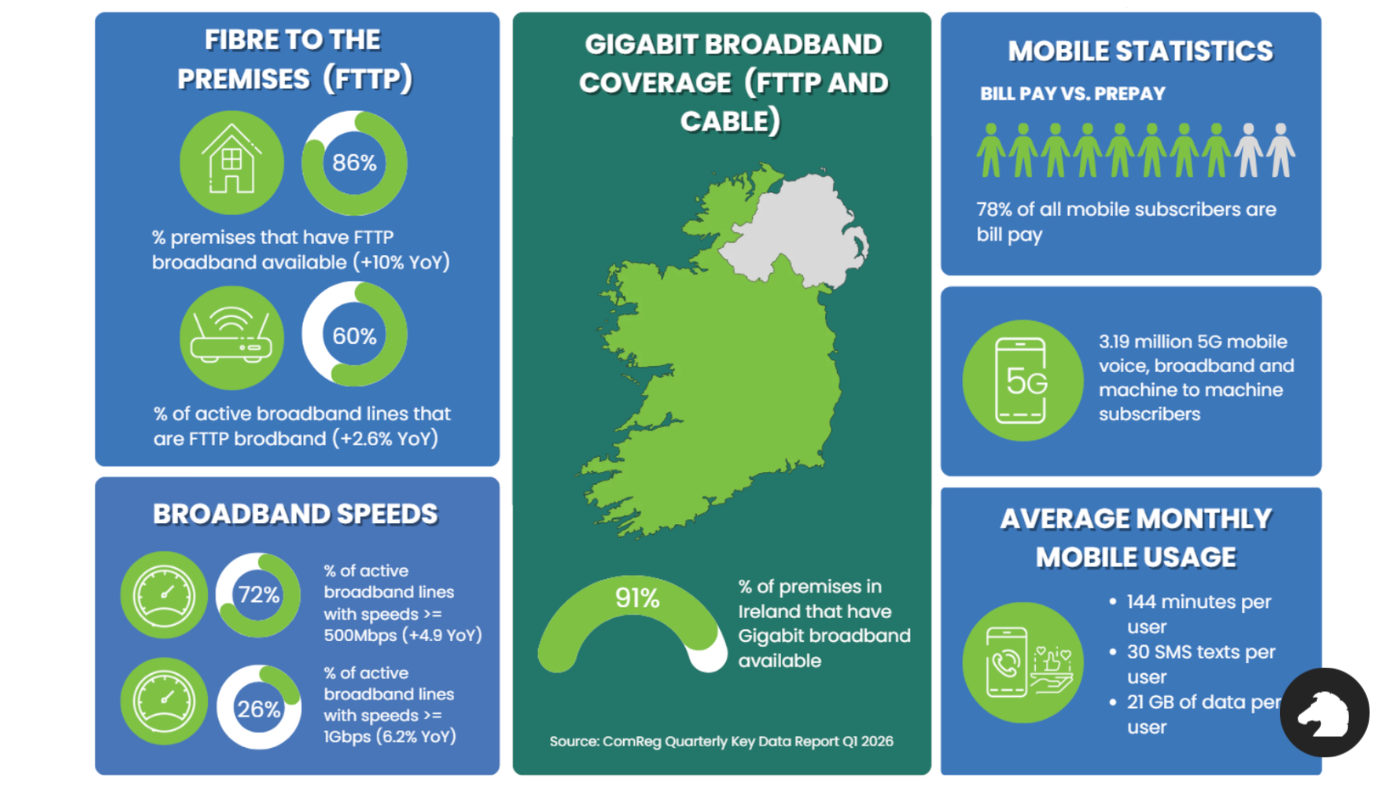
According to ComReg’s Quarterly Key Data Report for Q1 2026, FTTP subscriber lines reached 1.09 million, accounting for 62% of all fixed broadband connections in Ireland. That’s up from 53% a year ago and highlights the continued shift towards full-fibre connectivity.
Fibre Becomes the New Normal
For years, fibre rollout has been one of the biggest developments in Ireland’s communications infrastructure. The latest figures suggest we’re now reaching a turning point.
FTTP is available to 86% of premises nationwide, while gigabit-capable broadband is available to 91%. More importantly, people are signing up for these services. More than half of all premises where FTTP is available now have an active fibre connection.
Customers are also choosing faster broadband packages. Nearly three-quarters of fixed broadband subscribers now purchase services with speeds of 500Mbps or more, while 26% subscribe to gigabit services.
Among FTTP customers, 93% have broadband speeds of at least 500Mbps.
Data Usage Continues to Grow
As connectivity improves, so does demand.
The average residential broadband connection used 564GB of data per month during the quarter, up 13% year-on-year. Business broadband usage rose by 17% to 384GB per month.
The growth reflects increased use of cloud services, video conferencing, streaming, online gaming, remote working, and AI-powered applications.
For businesses, reliable high-speed connectivity is no longer a nice-to-have — it’s essential infrastructure.
Regional Progress Across Ireland
The report also highlights continued fibre expansion outside major urban centres.
Westmeath has the highest FTTP coverage in the country at 95%, while Westmeath and Longford lead for overall gigabit coverage at 96%.
These figures show that next-generation connectivity is becoming increasingly available across rural and regional Ireland, supporting remote working, local businesses, education, and digital services.
5G Growth Accelerates
The mobile market continues to evolve rapidly.
Total mobile subscriptions reached 10.9 million in Q1 2026, with bill-pay accounts representing 78% of all subscriptions.
One of the standout figures is the growth of 5G. Subscriber numbers increased to 3.1 million, up 52% year-on-year.
Mobile data usage also continues to rise. The average mobile subscriber now uses 21GB of data per month, while SMS usage continues its long-term decline.
What It Means
The latest ComReg figures reinforce a trend we’ve been watching for several years: Ireland is steadily moving towards a fibre-first, gigabit-capable future.
As fibre coverage and adoption continue to grow, consumers and businesses alike are benefiting from faster and more reliable connectivity. At the same time, rising data usage shows no sign of slowing as more of our work, entertainment, and everyday activities move online.
The message is clear: demand for high-quality connectivity continues to grow, and fibre is increasingly the technology delivering it.
Ready for Faster Broadband?
As fibre broadband becomes available to more homes and businesses across Ireland, many are choosing to upgrade to faster, more reliable connections. We offer a range of fibre broadband packages for homes and businesses. If you’re considering an upgrade, you can check availability on our website to see what broadband services are available in your area and find the package that best suits your needs, or contact us if you need any help.
About the Author: Alicia Stumke